Does buying dips in the FTSE 100 beat regular investing?

It has been said that time in the market beats trying to time the market, but is it true?

The content of this article was relevant at the time of publishing. Circumstances change continuously and caution should therefore be exercised when relying upon any content contained within this article.

You’re reading a free article with opinions that may differ from The Motley Fool’s Premium Investing Services. Become a Motley Fool member today to get instant access to our top analyst recommendations, in-depth research, investing resources, and more. Learn More.

The FTSE 100 dropped over 3% yesterday. Today it is down by another percentage point. In times like these, the question of whether buying dips in the market beats regular investing often gets asked. The answer may appear obvious. After all, buying dips means buying cheap. Regular investing could mean buying just before a dip or when the market is expensive. Should investors not aim to buy low and sell high?

A strategy of buying low and selling high makes intuitive sense, especially when we look at the performance of the FTSE 100 index.
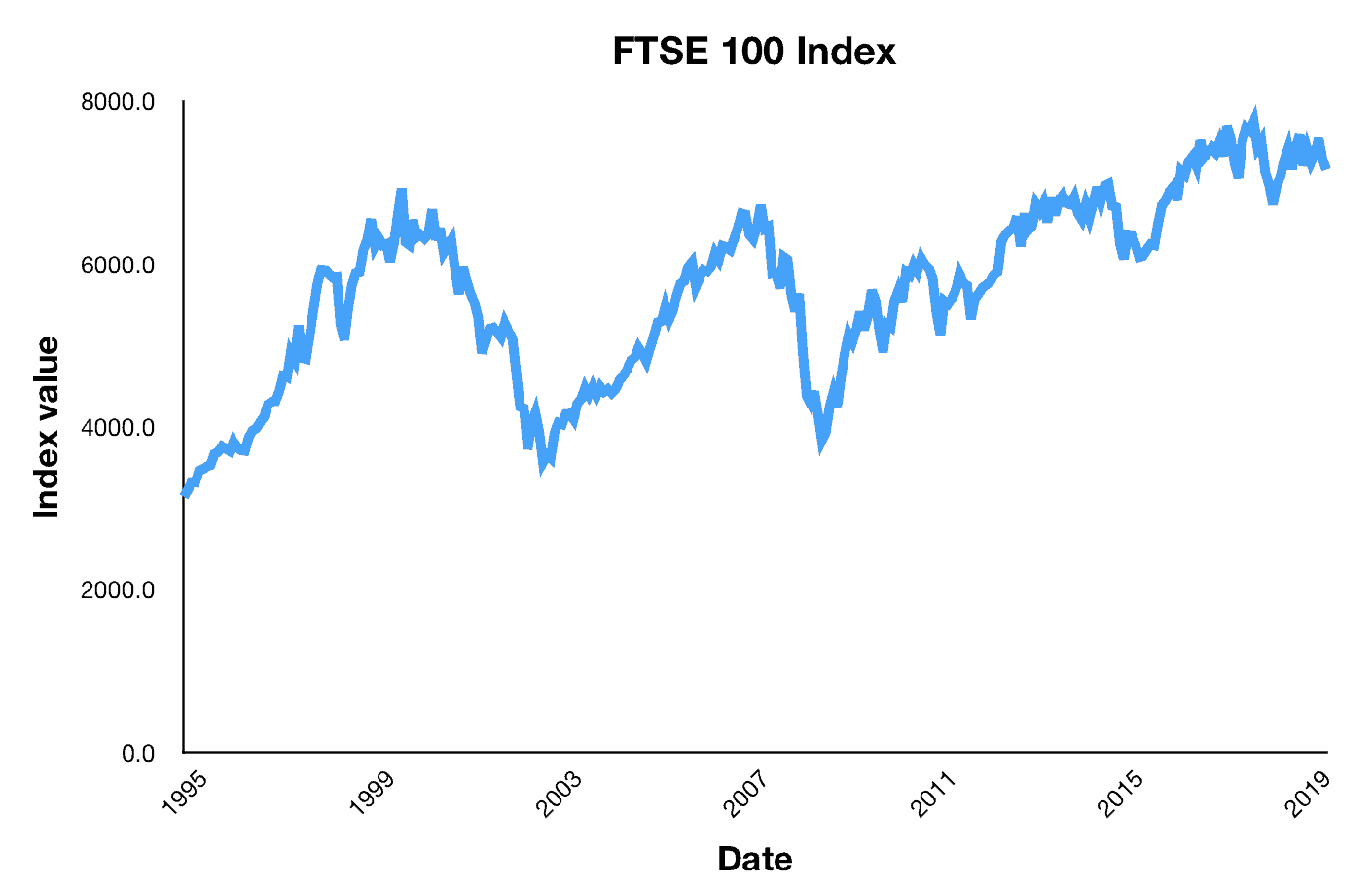
But the chart above shows the price of the index only. It does not account for the dividends that are paid by the companies in the index. The average annual dividend yield on the FTSE 100 from June 1993 to November 2018 was 3.47% or about 0.28% per month.

An investor in the FTSE 100 will receive these dividends if they buy all 100 stocks themselves or a fund that tracks the index. If dividends are being reinvested then the performance of the investment will not look like the chart above.

Dipping in

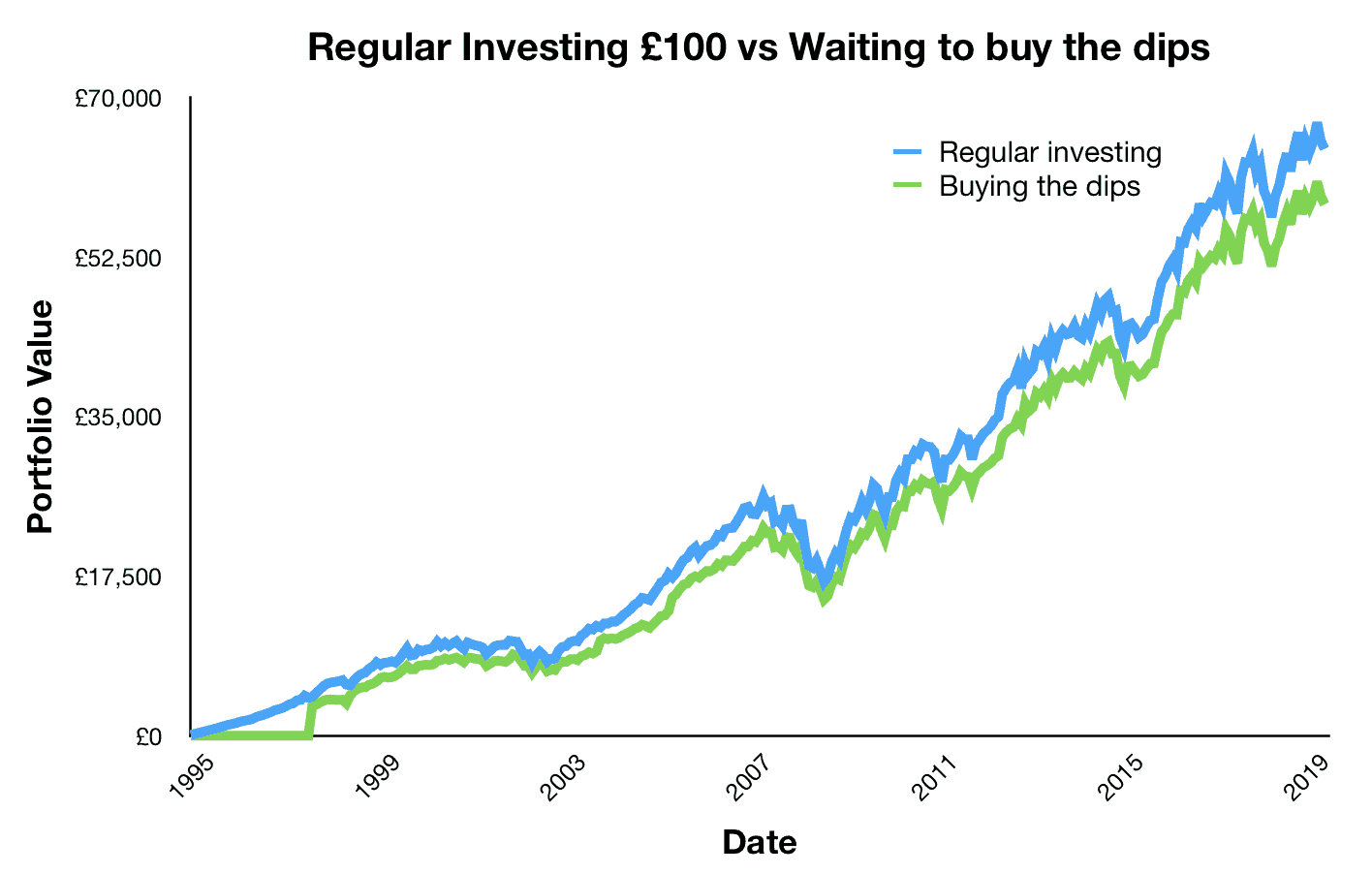
Let’s compare the two strategies. First, we will invest £100 every month in the FTSE 100 starting in March 1995 and finishing in January 2020. Second, we will look at a strategy of investing after the price of the FTSE 100 has fallen at least 5% in a month. To keep the total invested amounts similar, in the second strategy, £100 is either invested or banked until the index has fallen by 5%.

In total of £29,800 gets invested buying the dips and £30,000 in regular investments over the 25 or so years. How about the performance of the two strategies? Well, the regular investor ends up with £64,359 compared to £58,270 for the dip buyer. 
Along for the ride

Of the two strategies, regular investing comes out on top. The message is clear, don’t wait to buy the dip, just keep investing. The more time you are in the market, the more your money grows, assuming dividends are being paid and reinvested. The more you try to time the market, the less time your money has to grow.

I used data for the entire FTSE 100 for this exercise. There are some stocks that have higher dividend yields than the 3.47% average, so a diversified portfolio of those could have done even better.

Also bear in mind that this experiment was carried out with 25 years of monthly returns. The longer your investment time horizon, the more likely you are to do well. Looking back over the FTSE 100 price chart should make this point clear. If you only had two or three years to invest and you started around 1999 or 2007 you would have done badly. Long-term investing is the key to success.


Views expressed on the companies mentioned in this article are those of the writer and therefore may differ from the official recommendations we make in our subscription services such as Share Advisor, Hidden Winners and Pro. Here at The Motley Fool we believe that considering a diverse range of insights makes us better investors.

More on Investing Articles

Man hanging in the balance over a log at seaside in Scotland
Investing Articles

Will Lloyds shares rise 25% or 39% by this time next year?

Lloyds shares are expected to rebound after sinking to fresh multi-month peaks. Royston Wild considers the outlook for the FTSE…

Read more »

Modern suburban family houses with car on driveway
Investing Articles

£7,500 invested in Taylor Wimpey shares 18 months ago is now worth…

A raft of issues have been plaguing the housebuilding sector in the last year-and-a-half. How bad was the damage for…

Read more »

A rear view of a female in a bright yellow coat walking along the historic street known as The Shambles in York, UK which is a popular tourist destination in this Yorkshire city.
Investing Articles

£210 drip-fed into this 6.8%-yielding UK stock could lead to a £1,000 second income 

This FTSE 100 dividend stock has slumped nearly 11% inside two weeks, making it a worthy candidate to consider for…

Read more »

ISA Individual Savings Account
Investing Articles

ISA or SIPP? 2 factors to consider

As next month's ISA contribution deadline creeps up, our writer considers a couple of key differences between using a SIPP,…

Read more »

Portrait of pensive bearded senior looking on screen of laptop sitting at table with coffee cup.
Investing Articles

Is this 5.6% yielding dividend share a brilliant defensive bolthole as war rages?

Harvey Jones looks at a FTSE 100 dividend share with a brilliant record of delivering income and growth, and wonders…

Read more »

Hand of person putting wood cube block with word VALUE on wooden table
Investing Articles

2 quality UK stocks trading below intrinsic value?

UK stocks have a reputation for being cheap, but could value investors be in dreamland with the opportunities being presented…

Read more »

Businessman with tablet, waiting at the train station platform
Investing Articles

£15,000 put into Greggs shares a year ago is worth this much now…

Greggs' sausage rolls may be tasty enough -- but its shares have left a bad taste in some investors' mouths…

Read more »

Investing Articles

FTSE 100 drops sharply — are serious bargains emerging in UK stocks?

Andrew Mackie looks at the FTSE 100 and explores how sharp falls, market volatility, and structural opportunities are reshaping the…

Read more »