This FTSE 100 dividend stock is hated right now. That’s why I just bought more of it

Only a few years ago, this FTSE 100 (INDEXFTSE: UKX) dividend stock was in high demand.

| More on:

The content of this article was relevant at the time of publishing. Circumstances change continuously and caution should therefore be exercised when relying upon any content contained within this article.

You’re reading a free article with opinions that may differ from The Motley Fool’s Premium Investing Services. Become a Motley Fool member today to get instant access to our top analyst recommendations, in-depth research, investing resources, and more. Learn More.

Only a few years ago, Prudential (LSE: PRU) was the FTSE 100 insurance stock everyone wanted to own. Given its exposure to Asia – where demand for financial services products, such as insurance and savings accounts, is on the rise – investors were more than happy to pay a premium for the stock.

Recently, however, investor sentiment towards Prudential has deteriorated significantly. With growth in Asia slowing due to the ongoing US-China trade war and political protests continuing in Hong Kong (a major insurance hub), investors have dumped the stock, leaving it trading at a rock-bottom valuation.  

Near-term challenges

As a long-term investor who doesn’t mind going against the herd, this shift in sentiment towards Prudential has got me interested. Sure, the insurer faces some challenges in the near term. While the trade war continues and demonstrations continue in Hong Kong, profit growth could be muted. Yet from a long-term perspective, the growth story here remains very attractive, in my view.

Long-term growth story

You see, over the next decade, wealth across China and other countries in Asia is predicted to rise significantly. According to research from Legal & General, the percentage of China’s population with an income of $10,000 or more per year is set to rise to 60% by 2030, up from 35% in 2018, and less than 0.1% in 2000. What this means is that we could be looking at another 350m people or so earning this level of income over the next decade. To put that number in perspective, the population of the US last year was 327m.
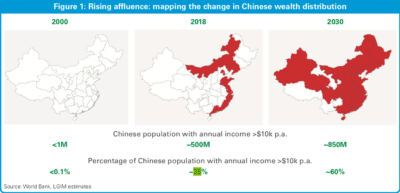
Source: Legal & General 

Now look what happens to consumption when income rises to $10,000 per year. As the graphic below shows, spending on insurance and healthcare soars as income increases to that level.
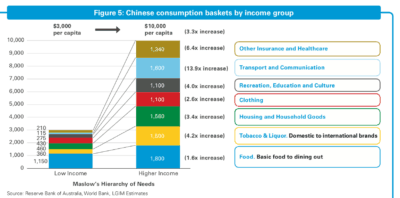
Source: Legal & General 

This suggests the growth potential for Prudential – which has been operating in China for more than 20 years and is looking to expand its presence in the country – over the next decade, is substantial.

Rock-bottom valuation

For the year ending 31 December 2020, City analysts expect Prudential to generate earnings per share of 162.8p. This means that at the current share price of 1313p, the forward-looking P/E ratio is just 8.1. For a company with so much growth potential, I see that valuation as an absolute steal. It’s worth noting that two years ago, the forward P/E was near 14.

I’ll also point out that with the shares out of favour, there’s a healthy dividend yield on offer. For the year ending 31 December, analysts expect a payout of 42p per share, which equates to a prospective yield of 3.2% (up from around 2.5% when the shares were in demand).

Looking at these metrics, I believe Prudential shares offer a lot of value right now. As such, I’ve just bought more of them for my ISA. I think in 10 years’ time, trade wars and Hong Kong protests will be a distant memory.


Edward Sheldon owns shares in Prudential and Legal & General Group. The Motley Fool UK has recommended Prudential. Views expressed on the companies mentioned in this article are those of the writer and therefore may differ from the official recommendations we make in our subscription services such as Share Advisor, Hidden Winners and Pro. Here at The Motley Fool we believe that considering a diverse range of insights makes us better investors.

More on Investing Articles

Young Asian woman with head in hands at her desk
Investing Articles

£5,000 invested in BP shares 2 days ago is now worth…

BP shares were in a very strong upward trend. However, in the last few days they have pulled back amid…

Read more »

A young black man makes the symbol of a peace sign with two fingers
Investing Articles

2 top FTSE 250 investment trusts to consider in April

The FTSE 250 is brimming with high-quality investment trusts. Our writer highlights two very different options, including a mid-cap newcomer.

Read more »

Edinburgh Cityscape with fireworks over The Castle and Balmoral Clock Tower
Investing Articles

After making a fortune on Tesla, this FTSE 250 trust has piled into a little-known S&P 500 stock

Baillie Gifford made huge profits from S&P 500 growth stocks like Nvidia. Lately, it's been snapping up a lesser-known tech…

Read more »

ISA coins
Investing Articles

How much do you need in a Stocks and Shares ISA to target a £1,200 a year passive income?

A FTSE 100 index fund comes with a 3% dividend yield. But can income investors find better opportunities for their…

Read more »

piggy bank, searching with binoculars
Value Shares

What’s going on with the Greggs share price now?

Dr James Fox takes a look at the Greggs share price which has suffered more than most over the past…

Read more »

Middle aged businesswoman using laptop while working from home
Dividend Shares

2 UK shares with over 20 years of consecutive dividend growth

Jon Smith points out a couple of UK shares with strong dividend credentials that lead him to dig deeper and…

Read more »

ISA Individual Savings Account
Investing Articles

1 penny stock I feel comfortable putting in a Stocks and Shares ISA

When picking assets for a Stocks and Shares ISA, penny stocks are usually low on the list. But I think…

Read more »

Young mixed-race woman jumping for joy in a park with confetti falling around her
Investing Articles

£20,000 invested in the FTSE 100 just 1 year ago would now be worth…

Historically speaking, we've just witnessed one of the single greatest 12-month stretches in the history of the FTSE 100 index.

Read more »